

Artificial Intelligence (AI) is no longer a future concept—it is already part of our daily lives. From chatbots and recommendation systems to smart assistants and automation tools, AI keeps evolving fast. Many people feel confused when they hear terms like Generative AI, AI Agents, and Agentic AI.
But don’t worry 😊
In this article, we will explain everything step by step, using simple language, real-life examples, and easy comparisons.
What Is Artificial Intelligence (AI)?
Artificial Intelligence means making machines smart.
AI helps computers think, learn, and make decisions like humans.
Examples of AI you already know:
- Google search suggestions
- YouTube video recommendations
- Voice assistants like Alexa or Siri
Now, let’s understand the three important AI types.
What Is Generative AI?
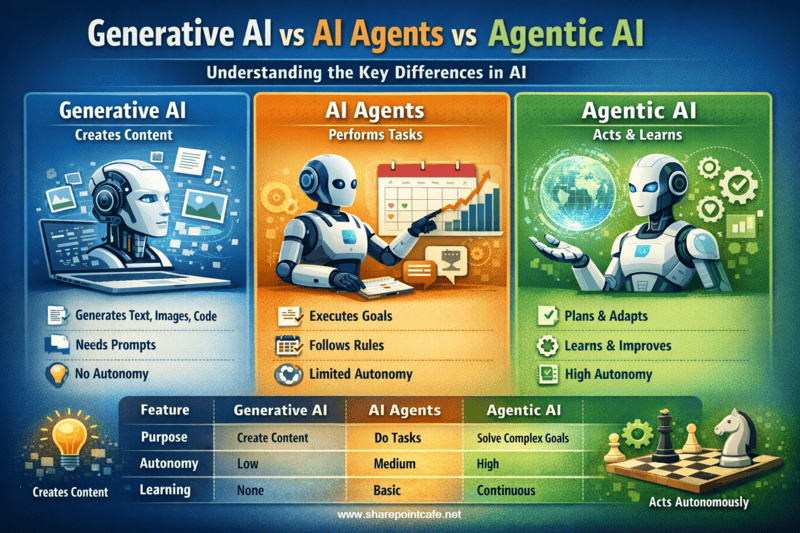
Generative AI is a type of AI that can create new things.
It can:
- Write stories
- Create images
- Make music
- Answer questions
- Generate code
Simple Example:
Imagine a very smart student who can write an essay for you when you give a topic.
That student does not think on their own. They only respond when you ask.
That is how Generative AI works.
Real-Life Examples:
- Writing an essay
- Creating an image from text
- Generating a poem or story
Important Point:
👉 Generative AI waits for your command.
It does not act on its own.
How Generative AI Works (In Simple Words)
- It studies a huge amount of data (text, images, code, etc.).
- It learns patterns, structure, and relationships.
- When you give a prompt, it predicts and generates new content.
What Are AI Agents?
An AI Agent is smarter than Generative AI.
It does not just create content—it can perform tasks.
What Can an AI Agent Do?
- Follow instructions
- Take actions
- Use tools
- Complete steps one by one
Simple Example:
Imagine a robot assistant:
- You say: “Book a movie ticket”
- It checks available movies
- Selects seats
- Confirms the booking
That robot is an AI Agent.
How AI Agents Work
- They receive a goal or task.
- They observe the environment (data, systems, APIs).
- They decide the best action.
- They act and repeat until the goal is achieved.
Key Difference from Generative AI:
- Generative AI only creates
- AI Agents do + act
What Is Agentic AI?
Now comes the most advanced one—Agentic AI.
Agentic AI means AI that can:
- Think independently
- Set goals
- Plan steps
- Make decisions
- Act without constant human instructions
Simple Example:
Imagine a self-driven student:
- They know exams are coming
- They create a study plan
- They revise weak subjects
- They adjust the plan if something goes wrong
That is Agentic AI.
Real-Life Example:
- A system that manages a company’s customer support automatically
- An AI that finds problems and fixes them without asking you
Important Point:
👉 Agentic AI acts like a decision-maker, not just a helper.
Core Characteristics of Agentic AI
- High autonomy
- Long-term planning
- Self-reflection
- Decision-making
- Tool usage
Easy Comparison Table
| Feature | Generative AI | AI Agents | Agentic AI |
|---|---|---|---|
| Creates content | ✅ Yes | ✅ Yes | ✅ Yes |
| Takes actions | ❌ No | ✅ Yes | ✅ Yes |
| Works without command | ❌ No | ❌ Limited | ✅ Yes |
| Sets goals | ❌ No | ❌ No | ✅ Yes |
| Thinks independently | ❌ No | ❌ No | ✅ Yes |
Simple Way to Remember
- Generative AI → Creates things when asked
- AI Agents → Performs tasks step by step
- Agentic AI → Plans, decides, and acts on its own
Why Is This Important to Learn?
These AI technologies will:
- Change education
- Improve jobs
- Automate businesses
- Create new careers
Understanding them early gives students and professionals a big advantage in the future.
Why Agentic AI Is the Future
The AI world is shifting from tools to digital collaborators.
- Generative AI helped us create
- AI agents helped us automate
- Agentic AI will help us delegate
This evolution will transform industries like healthcare, education, finance, software development, and marketing.
Frequently Asked Questions (FAQs)
1. What is the main difference between Generative AI and AI Agents?
The main difference is action.
Generative AI only creates content like text, images, or code when you ask it.
AI Agents can perform tasks, follow steps, and use tools to complete work.
2. Can Generative AI work without human instructions?
No.
Generative AI always waits for a command from a human. It cannot decide or act on its own.
3. Is Agentic AI the same as AI Agents?
No, they are different.
AI Agents can do tasks but usually follow human instructions.
Agentic AI can set goals, plan actions, and make decisions by itself.
4. Is Agentic AI dangerous?
Agentic AI is not dangerous by default.
However, people must use it responsibly and with rules, because it can make independent decisions. That is why companies test it carefully before real-world use.
5. Which AI is best for students?
For students:
- Generative AI is best for learning, writing, and creativity
- AI Agents help with productivity
- Agentic AI is more useful for advanced systems, not daily schoolwork yet
6. Can AI replace teachers or humans?
No.
AI can support humans, but it cannot replace human thinking, emotions, creativity, and values. Teachers and humans are always important.
7. Where do we see Agentic AI in real life?
Agentic AI is used in:
- Smart automation systems
- Advanced business workflows
- Research and simulations
- Autonomous decision-making tools
Most examples are still in development.
8. Which AI technology will grow the fastest?
Agentic AI is expected to grow the fastest because companies want AI systems that can think, plan, and act independently with less human effort.
9. What should I remember in one line?
- Generative AI creates
- AI Agents act
- Agentic AI decides
Final Thoughts
AI is not scary when we understand it properly.
Generative AI helps us create, AI Agents help us do work, and Agentic AI helps us think and decide automatically.
As AI grows, learning these basics will help everyone—from students to working professionals—stay ahead in the digital world.
Keep Following: SharePointcafe.NET








Leave a Reply