
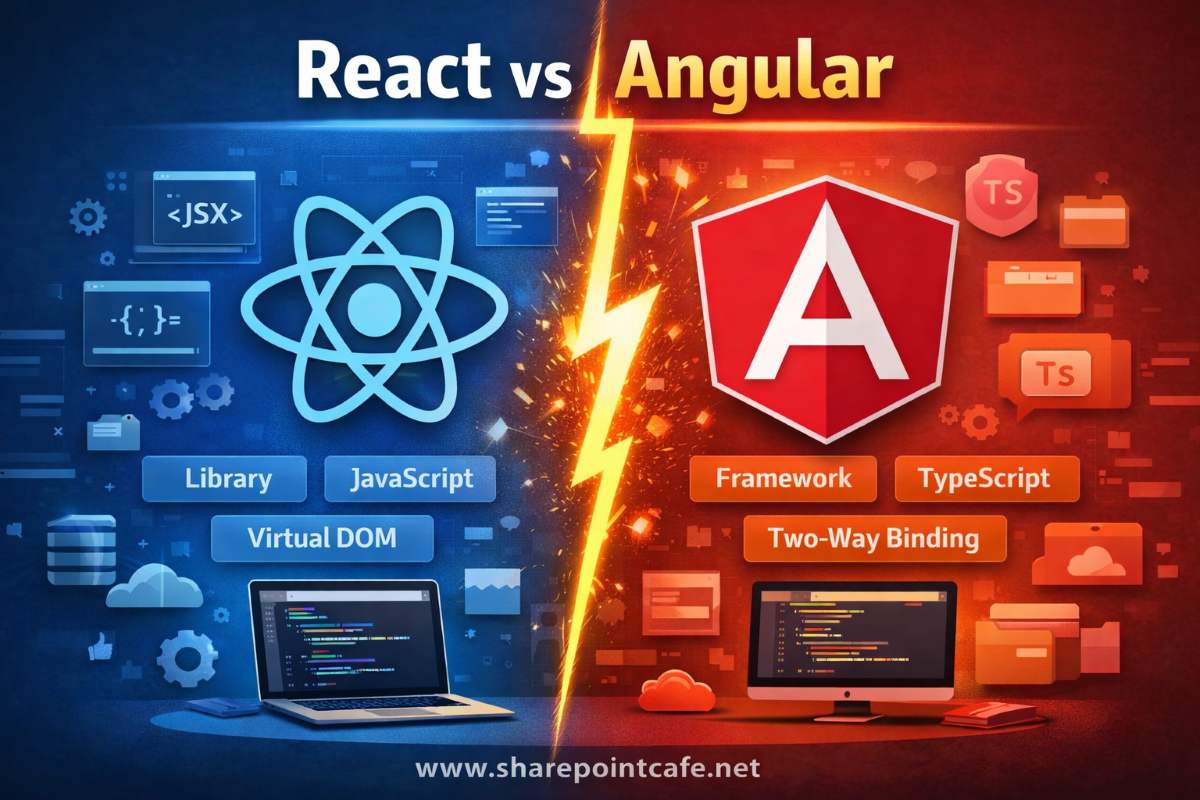

Choosing the right front-end technology is one of the most important decisions in modern web development. Two of the most popular options are React and Angular. Both are powerful, widely used, and supported by strong communities. However, they follow different philosophies and suit different types of projects.
In this article, you will understand everything from their origins to syntax, project structure, use cases, roadmap, and pros & cons. This guide is written about React vs Angular in simple and easy language so you can easily decide which one fits your needs.
1. Introduction: Who Created React and Angular?
React
React was created by Jordan Walke, a software engineer at Facebook (now Meta). Facebook first released React in 2013. It is a JavaScript library used for building user interfaces, especially single-page applications (SPAs).
React focuses only on the view layer, which means developers need to use additional tools for routing, state management, and other features.
Angular
Angular was developed by Google. The first version, AngularJS, was released in 2010. Later, Google completely rewrote it and released Angular (version 2+) in 2016.
Angular is a full-fledged framework, not just a library. It provides everything needed to build large-scale applications out of the box.
2. Basic Comparison: React vs Angular
| Feature | React | Angular |
|---|---|---|
| Type | Library | Framework |
| Language | JavaScript / JSX | TypeScript |
| Learning Curve | Easy to moderate | Moderate to difficult |
| Data Binding | One-way | Two-way |
| DOM | Virtual DOM | Real DOM |
| Flexibility | High | Structured |
| Maintained By | Meta (Facebook) |
3. Where to Use React and Angular?
Use React When:
- You want flexibility in choosing tools
- You are building dynamic UI-heavy apps
- You prefer fast development
- You are working on startup projects or MVPs
- You need high performance with frequent updates
Examples:
- Social media apps
- Dashboards
- E-commerce frontends
Use Angular When:
- You want a complete framework
- You are building large enterprise applications
- You prefer strict structure and conventions
- You need built-in tools like forms, routing, HTTP
Examples:
- Banking systems
- Enterprise dashboards
- Large-scale internal tools
4. Basic Syntax Comparison
React Syntax (JSX)
React uses JSX, which looks like HTML inside JavaScript.
function App() {
  return <h1>Hello, React!</h1>;
}- Simple and readable
- Combines HTML + JavaScript
- Easy for beginners
Angular Syntax (TypeScript + HTML Templates)
<h1>{{ title }}</h1>export class AppComponent {
title = 'Hello Angular';
}- Uses separate files for logic and template
- Uses TypeScript (strict typing)
- Better for large-scale apps
5. Project Structure
React Project Structure
React projects are flexible. A typical structure looks like this:
src/
 ├── components/
 ├── pages/
 ├── services/
 ├── App.js
 ├── index.js
Angular Project Structure
Angular follows a strict and organized structure:
src/
 ├── app/
 │   ├── components/
 │   ├── services/
 │   ├── modules/
 │   ├── app.component.ts
 │   ├── app.module.ts
6. Best Compatible Technology for API
React API Integration
React works best with:
- Node.js + Express
- REST APIs
- GraphQL (Apollo Client)
It is flexible, so you can connect it with any backend.
Angular API Integration
Angular has built-in support using:
- HttpClient Module
- Works well with:
- .NET APIs
- Java Spring Boot
- Node.js
It also provides better structure for API calls.
7. Roadmap for Learning React
If you want to learn React, follow this roadmap:
1: Basics
- HTML, CSS, JavaScript
- ES6 features
2: React Fundamentals
- Components
- Props & State
- JSX
3: Advanced Concepts
- Hooks (useState, useEffect)
- Context API
- Routing (React Router)
4: State Management
- Redux or Zustand
5: API Integration
- Axios / Fetch API
6: Testing & Optimization
- Jest
- Performance optimization
8. Roadmap for Learning Angular
1: Basics
- HTML, CSS, JavaScript
- TypeScript (important)
2: Angular Fundamentals
- Components
- Modules
- Data binding
3: Advanced Topics
- Services & Dependency Injection
- Routing
- Reactive Forms
4: API Handling
- HttpClient
5: State Management
- NgRx (Redux for Angular)
6: Testing
- Jasmine & Karma
9. Which is Better in What?
React is Better For:
- Faster development
- Small to medium projects
- High UI customization
- Performance (Virtual DOM)
Angular is Better For:
- Large enterprise apps
- Structured development
- Built-in tools
- Strong typing with TypeScript
10. Pros and Cons of React
Pros
- Easy to learn
- High flexibility
- Large community
- Fast rendering with Virtual DOM
- Reusable components
Cons
- Requires multiple libraries
- Less structure
- State management can be complex
11. Pros and Cons of Angular
Pros
- Complete framework
- Strong structure
- Built-in features (routing, forms, HTTP)
- TypeScript support
- Good for large teams
Cons
- Steep learning curve
- More boilerplate code
- Slower initial setup
- Less flexibility
12. Final Verdict: React vs Angular
There is no one-size-fits-all answer. The best choice depends on your project and team.
- Choose React if you want speed, flexibility, and modern UI.
- Choose Angular if you want structure, scalability, and enterprise-level features.
Many companies even use both depending on their needs.
13. Conclusion
React and Angular are both powerful tools in modern web development. React gives you freedom and speed, while Angular gives you structure and completeness.
If you are a beginner, React is easier to start with. If you are working in a large organization, Angular may suit you better.
The best approach is to learn both and choose based on your project requirements.
Keep Following: SharePointCafe.NET









Leave a Reply