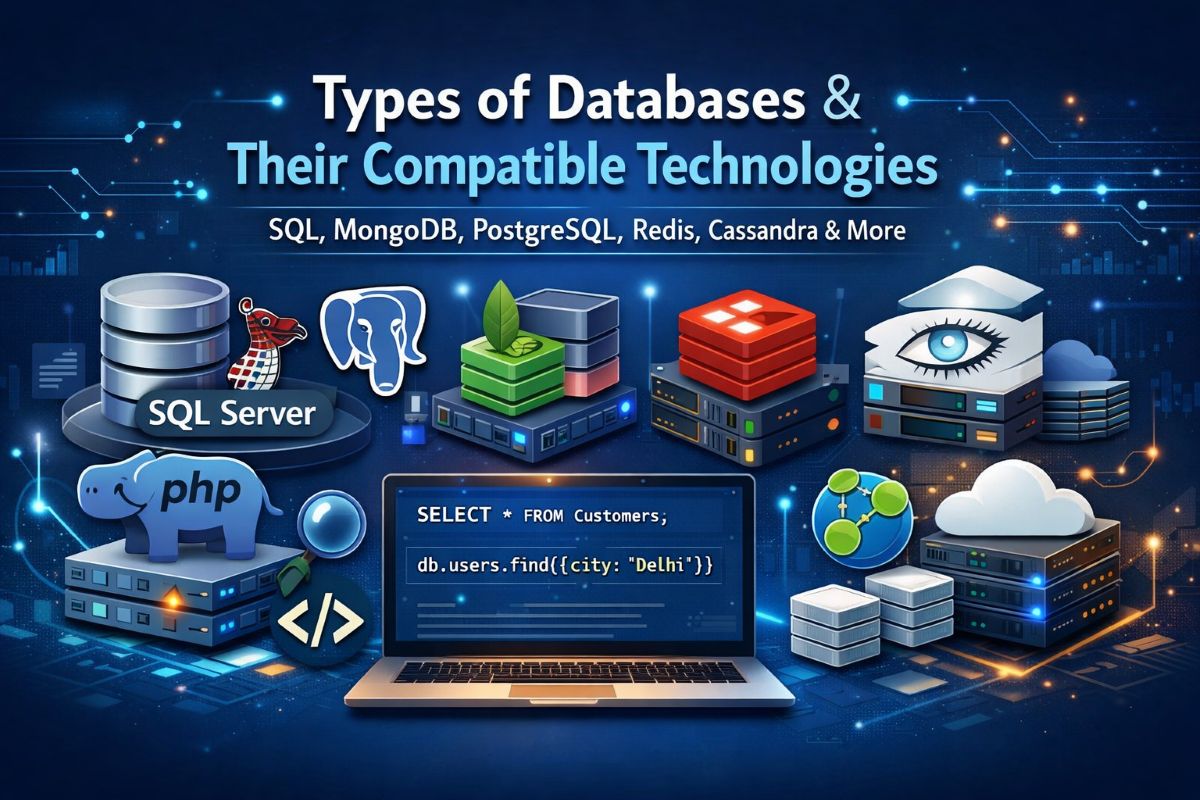

Modern applications depend on databases to store, manage, and retrieve data efficiently. From social media platforms to banking systems, every software application uses a database in some form. However, not all databases work the same way. Different databases are designed for different purposes, technologies, and workloads.
In this article, we will explore the major types of databases, their preferred technologies, why developers prefer them, and basic query examples to understand how they work. This guide uses simple language and active voice, making it easy for beginners and developers to understand.
1. Relational Databases (SQL Databases)
Relational databases store data in tables consisting of rows and columns. Each table represents an entity, and relationships between tables help organize data efficiently.
They use Structured Query Language (SQL) to manage data.
Common relational databases include:
- Microsoft SQL Server
- MySQL
- PostgreSQL
- Oracle Database
Relational databases work best for structured data and transactional systems.
Microsoft SQL Server
Microsoft SQL Server is a powerful relational database developed by Microsoft. It is widely used in enterprise applications.
Preferred Technology
- .NET Framework / .NET Core
- C#
- ASP.NET
- Azure services
Why It Is Preferred
SQL Server integrates tightly with the Microsoft ecosystem. Developers using .NET technologies find it easy to connect and manage data because Microsoft provides built-in libraries like ADO.NET and Entity Framework.
Example Use Case
Banking applications, ERP systems, and corporate dashboards often use SQL Server.
Example Schema
CREATE TABLE Customers (
    CustomerID INT PRIMARY KEY,
    Name VARCHAR(100),
    Email VARCHAR(100),
    City VARCHAR(50)
);
INSERT INTO Customers (CustomerID, Name, Email, City)
VALUES (1, 'Rahul Sharma', 'rahul@email.com', 'Delhi');SELECT * FROM Customers;MySQL
MySQL is one of the most popular open-source relational databases. Many websites and web applications rely on it.
Preferred Technology
- PHP
- WordPress
- Laravel
- Python
- Node.js
Why It Is Preferred
MySQL works extremely well with PHP-based applications. That is why most websites built using WordPress, Joomla, and Drupal use MySQL.
It is fast, reliable, and easy to deploy.
Example Use Case
- Blogging platforms
- E-commerce websites
- Content management systems
Example Schema
CREATE TABLE Products (
    ProductID INT PRIMARY KEY,
    ProductName VARCHAR(100),
    Price DECIMAL(10,2)
);

INSERT INTO Products VALUES (101, 'Laptop', 60000);
Query Data
SELECT ProductName, Price FROM Products;PostgreSQL
PostgreSQL is an advanced open-source relational database known for reliability and performance.
Preferred Technology
- Python (Django)
- Node.js
- Java
- Go
- Ruby on Rails
Why It Is Preferred
PostgreSQL supports advanced features such as:
- JSON support
- Complex queries
- Custom data types
- Strong security
Frameworks like Django prefer PostgreSQL because it handles complex data structures efficiently.
Example Use Case
- Data analytics systems
- financial systems
- GIS applications
Example Schema
CREATE TABLE Employees (
    emp_id SERIAL PRIMARY KEY,
    name VARCHAR(100),
    salary INT
);
Insert Data
INSERT INTO Employees (name, salary)
VALUES ('Amit', 50000);
Query Data
SELECT * FROM Employees;NoSQL Databases
NoSQL databases store data in non-tabular formats. They are designed to handle large-scale and flexible data structures.
Common types include:
- Document databases
- Key-value databases
- Column databases
- Graph databases
MongoDB (Document Database)
MongoDB is a popular NoSQL document database. Instead of tables, it stores data in JSON-like documents.
Preferred Technology
- Node.js
- JavaScript
- MERN stack (MongoDB, Express, React, Node)
- Python
Why It Is Preferred
MongoDB works naturally with JavaScript-based applications. Since data is stored as JSON documents, it integrates easily with web applications.
Example Use Case
- Real-time applications
- Social media platforms
- Content-based systems
Example Document Schema
{
  "name": "Ravi",
  "age": 25,
  "city": "Delhi"
}
Insert Document
db.users.insertOne({
   name: "Ravi",
   age: 25,
   city: "Delhi"
})
Query Document
db.users.find({city: "Delhi"})Redis (Key-Value Database)
Redis is an in-memory key-value database designed for extremely fast data access.
Preferred Technology
- Node.js
- Python
- Java
- Microservices architectures
Why It Is Preferred
Redis stores data in memory, making it very fast. Developers use it for:
- caching
- session storage
- real-time analytics
Example Use Case
- caching website data
- gaming leaderboards
- real-time chat systems
Basic Commands
Set a value
SET user:1 "Rahul"Get value
GET user:1Neo4j (Graph Database)
Neo4j is a graph database designed to manage relationships between data.
Preferred Technology
- Java
- Spring Boot
- Python
- Data science tools
Why It Is Preferred
Graph databases work best when relationships between data matter more than the data itself.
Example Use Case
- Social networks
- Recommendation engines
- Fraud detection systems
Example Graph Query (Cypher)
Create nodes
CREATE (a:Person {name:"Rahul"})
CREATE (b:Person {name:"Amit"})
Create relationship
CREATE (a)-[:FRIEND]->(b)Query relationship
MATCH (p:Person)-[:FRIEND]->(friend)
RETURN p, friend
Cassandra (Column Database)
Apache Cassandra is a distributed NoSQL database designed for large-scale applications.
Preferred Technology
- Java
- Big Data platforms
- Apache Spark
- Streaming systems
Why It Is Preferred
Cassandra provides:
- high availability
- massive scalability
- fault tolerance
Companies like Netflix and Facebook use Cassandra.
Example Table
CREATE TABLE users (
 id UUID PRIMARY KEY,
 name TEXT,
 city TEXT
);
Query Data
SELECT * FROM users;Choosing the Right Database
Developers choose databases based on project requirements.
| Database | Type | Preferred Technology | Best For |
|---|---|---|---|
| SQL Server | Relational | .NET | Enterprise applications |
| MySQL | Relational | PHP | Websites |
| PostgreSQL | Relational | Python / Django | Data-heavy apps |
| MongoDB | NoSQL | Node.js | Flexible web apps |
| Redis | Key-Value | Microservices | Caching |
| Neo4j | Graph | Java | Relationship data |
| Cassandra | Column | Big Data | Distributed systems |
Conclusion
Databases play a crucial role in modern software development. Each database has its own strengths and works best with certain technologies.
- SQL Server integrates well with the Microsoft ecosystem.
- MySQL powers millions of websites.
- PostgreSQL handles complex data structures.
- MongoDB provides flexibility for modern web applications.
- Redis delivers lightning-fast caching.
- Neo4j manages complex relationships.
- Cassandra supports large-scale distributed systems.
Choosing the right database depends on data structure, scalability needs, and application architecture.
Understanding these differences helps developers design efficient, scalable, and high-performance applications.









Leave a Reply